(7000) Curie
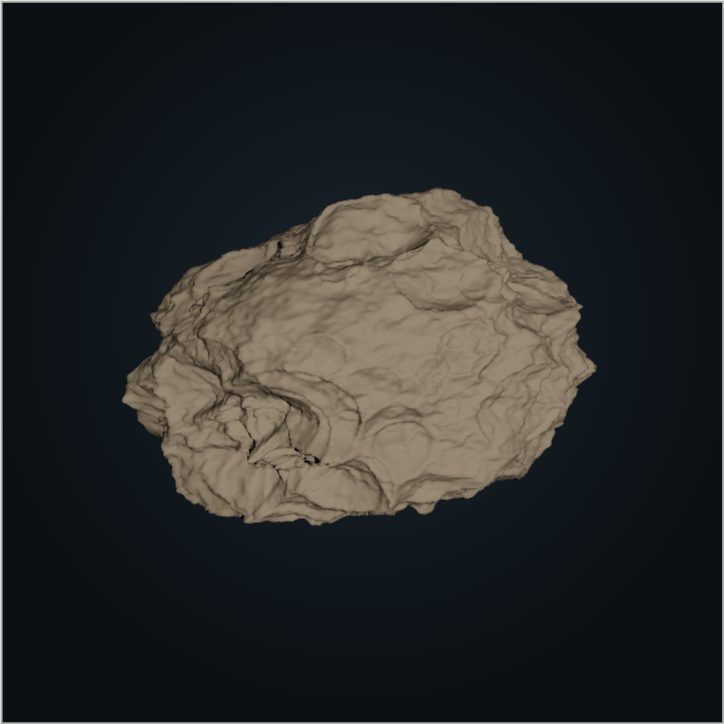
A rock 6–8 km across, circling the Sun between Mars and Jupiter. It bears the name of two scientists: Marie Skłodowska-Curie (1867–1934) and Pierre Curie (1859–1906).
Right now: –.–– au from the Sun and –.–– au from Earth — its light takes –– minutes to reach us.
Sources and notes
The diameter has been measured — the switch shows the smallest (6.29 km; Myhrvold et al. 2022) and the largest (7.72 km; Masiero et al. 2021) of three results from infrared observations. Shape and rotation are illustrative. Light falls at the angle at which the asteroid is seen from Earth today (—).
There is a shape model of asteroid Curie derived from light curves (DAMIT database, model 19723 from October 2026), but it has a low quality rating, no scale, and rests on a rotation period that is disputed. So the model at the top is a compact, moderately elongated body rather than that model.
- How big? 6.3 to 7.7 km across — measured in the infrared by the WISE satellite.
- How fast does it orbit? One trip around the Sun takes 3 years and 10 months.
- Can I see it? Not with the naked eye. At the best oppositions (2028, 2032) about magnitude 14.5–15 — an amateur telescope with a camera.
- Is it a threat? No. Its orbit never comes closer than about 125 million km to Earth’s orbit.
How big is it?
Unlike most asteroids, asteroid Curie has a measured diameter — derived from the heat it gives off. The WISE/NEOWISE satellite observed it in the infrared, and three independent analyses of those data gave 6.29, 6.497 and 7.72 km. We do not average them: they use different models and data sets, each with its own uncertainty.
If asteroid Curie stood outside Paris
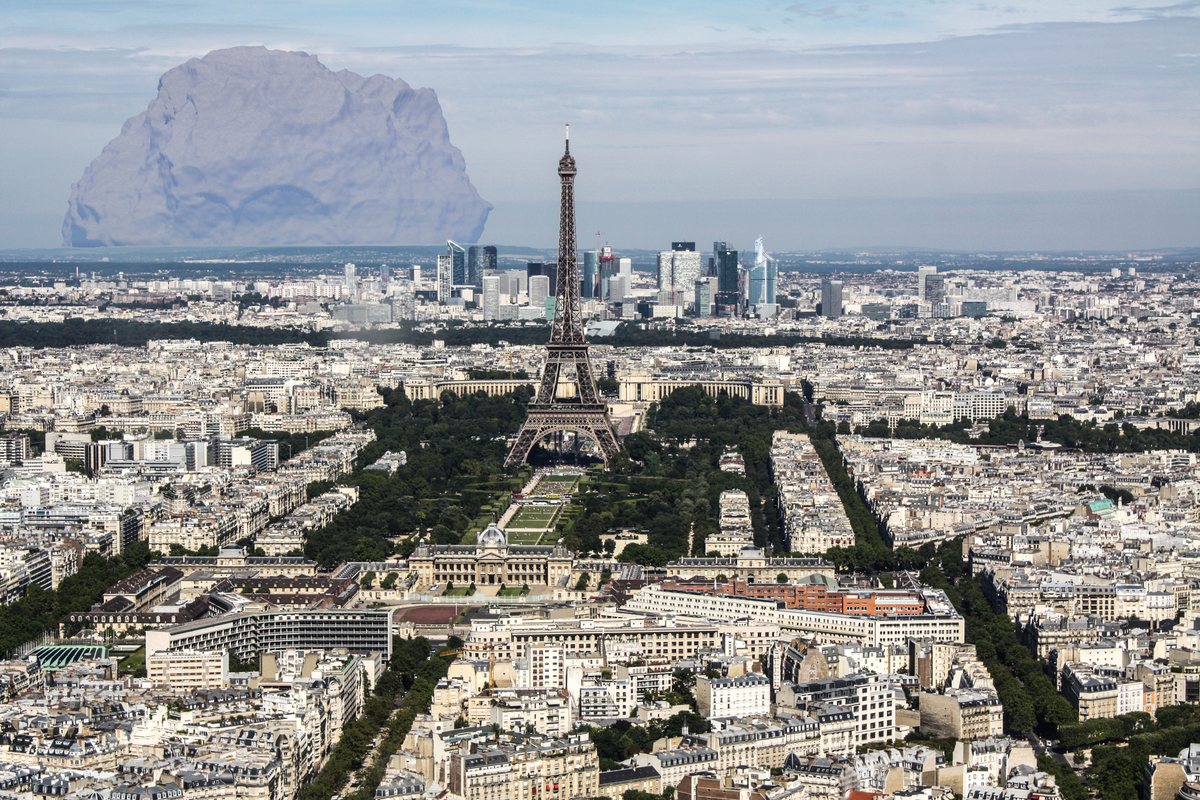
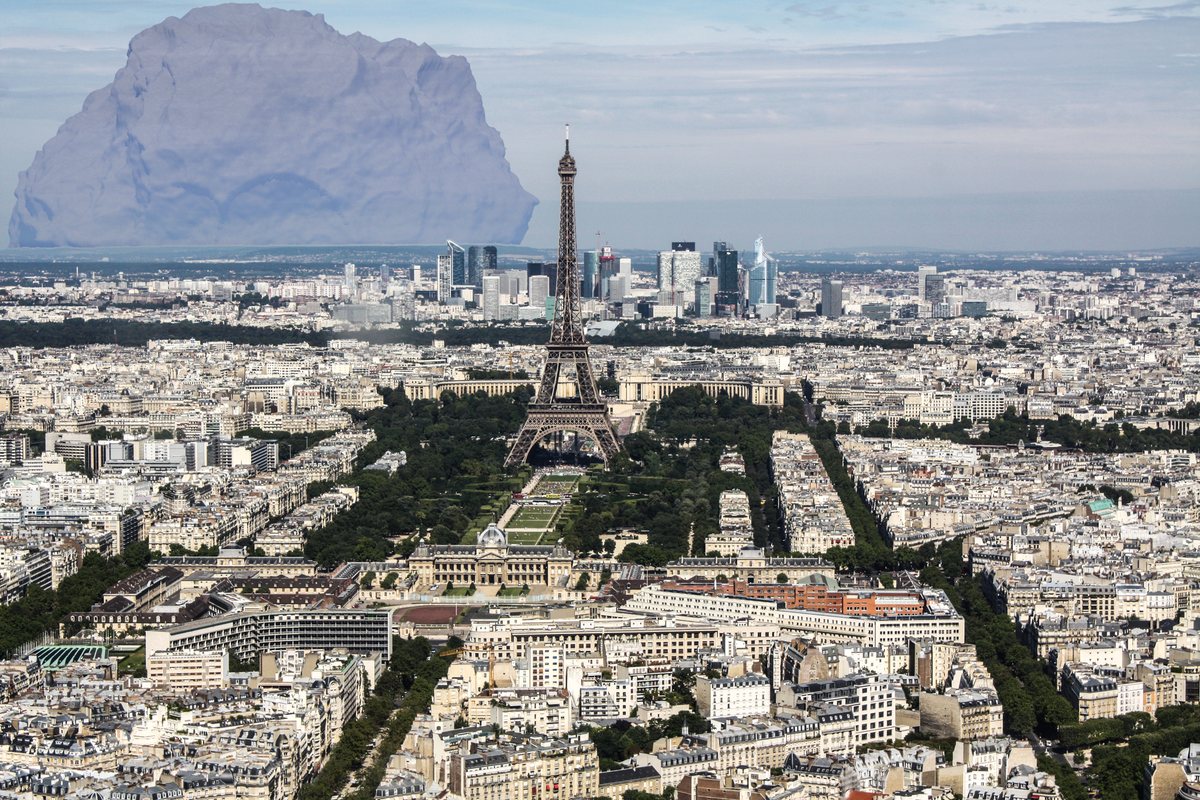 scale comparison · not an impact
Sources and notes
Photograph: Shadowgate, “Montparnasse (12519877323).jpg” (15 August 2013), Wikimedia Commons, licence CC BY 2.0. Changes: an asteroid body added from the same generator as the 3D model at the top of the page, with matched lighting and haze.

How it was made: the camera direction and focal length were recovered from the Eiffel Tower (antenna tip and base; 324 m tall in 2013). The Sun is placed where it was when the photo was taken (time from EXIF data). Everything in the photo that is not sky hides the body. Haze as on a very clear day, decreasing with height (an aerosol layer about 1 km deep); the foot of the body is hidden behind the hills west of Paris (the skyline from the photograph). The diameter is that of a sphere of equal volume: 6.29 km (Myhrvold et al. 2022) or 7.72 km (Masiero et al. 2021). Rock textures: Poly Haven (CC0).
Compared with asteroids visited by spacecraft and radar
Asteroid Curie (a body 6.5 km across — the middle of three measurements, 6.3–7.7 km) next to asteroids with measured shapes, all to one scale. Only Gaspra, visited by the Galileo spacecraft, is larger; Šteins from the Rosetta mission is a little smaller, and the rest several times smaller. Click a name to see the body close up.
Sources and notes
Shapes: Itokawa, Ryugu, Didymos, Šteins (Rosetta, Jorda et al. 2012) and Gaspra (Galileo, Thomas et al. 1994) — from spacecraft; Bennu, Moshup, Geographos — from radar (NASA PDS and JAXA DARTS archives), simplified to about 2,500 triangles. Dinkinesh and 1996 FG3 have no public shape model.
Three diameter measurements — why do they differ?
| Analysis | Diameter | Albedo | Notes |
|---|---|---|---|
| Myhrvold, Pinchuk, Margot 2022 | 6.29 ± 0.1 km | 0.321 ± 0.075 | a reanalysis of four WISE bands; with the second variant of the absolute magnitude the albedo is 0.253 ± 0.059 for the same diameter |
| Masiero et al. 2011 | 6.497 ± 0.030 km | 0.382 ± 0.051 | WISE in its cryogenic phase; the authors add that the real accuracy is about 10% for the diameter and at least 20% for the albedo |
| Masiero et al. 2021 | 7.72 ± 1.46 km | 0.242 (+0.139 / −0.088) | NEOWISE, mission year 7, only the two shorter bands and an assumed thermal-model parameter — hence the large uncertainty |
The albedo also depends on the adopted absolute magnitude H, which differs between catalogues and dates (12.60–13.03). The 7.64 km in the LCDB light-curve database is not a measurement but an estimate from H and an assumed albedo of 0.20.
How fast does it spin? Nobody knows
The orbit of asteroid Curie is known very precisely — from more than 8,000 observations over 87 years. Its rotation is the opposite: publications give three completely different answers, and none is settled today.
- about 6.2 hFrom an infrared light curve (WISE; Lam et al. 2023). The series lasted only about 100 hours, so the method could not, by design, find periods hundreds of hours long.
- about 317 hFrom brightness measurements by the Gaia satellite (Cellino et al. 2024; MacLennan et al. 2026). Both use the same data, so they are not two independent confirmations.
- about 800 hFrom ground-based observations by amateur astronomers in 2024 (Colazo et al. 2025: 805 ± 20 h) and from the shape model in the DAMIT database (799.7 h).
800 hours is more than a month per turn — if confirmed, asteroid Curie would be among the very slow rotators. The DAMIT model, its spin axis and the 799.7 h period form one set; other studies give other axis directions. Only further long series of observations can settle it.
Who were the namesakes?
The asteroid honours both: Marie Skłodowska-Curie (7 November 1867, Warsaw – 4 July 1934, Sancellemoz, Passy) and Pierre Curie (15 May 1859, Paris – 19 April 1906, Paris). The official naming citation (MPC 27464) describes Marie’s achievements, then Pierre’s, and states plainly: “The name also honors Pierre Curie (1859-1906)”.
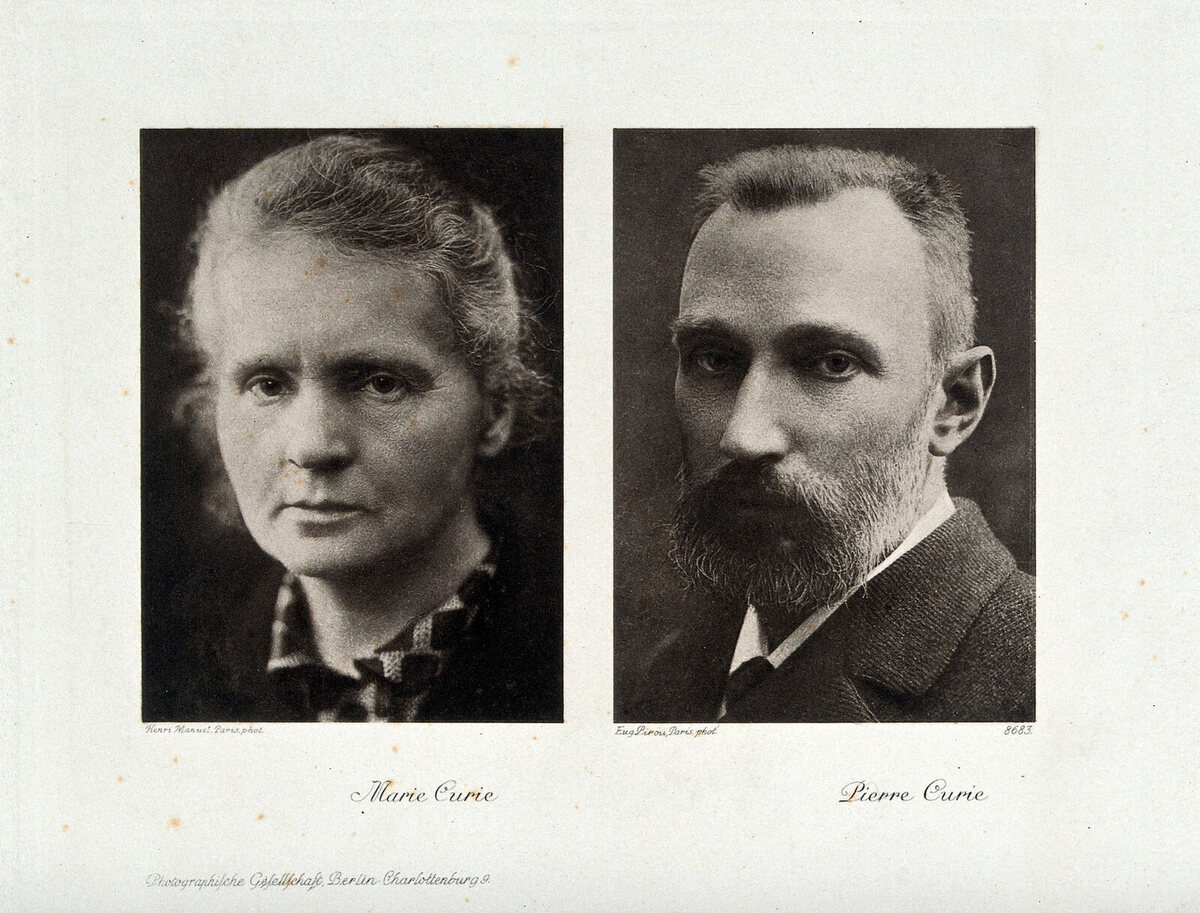
More about the namesakes: polonium, radium, two Nobel Prizes and the Panthéon
They married in 1895 in Sceaux. Radioactivity was discovered in 1896 by Henri Becquerel; the Curies’ research led to the discovery of new elements. In July 1898 Pierre and Marie announced polonium, and in December — together with Gustave Bémont — radium. Discovering an element did not yet mean obtaining a pure sample of it.
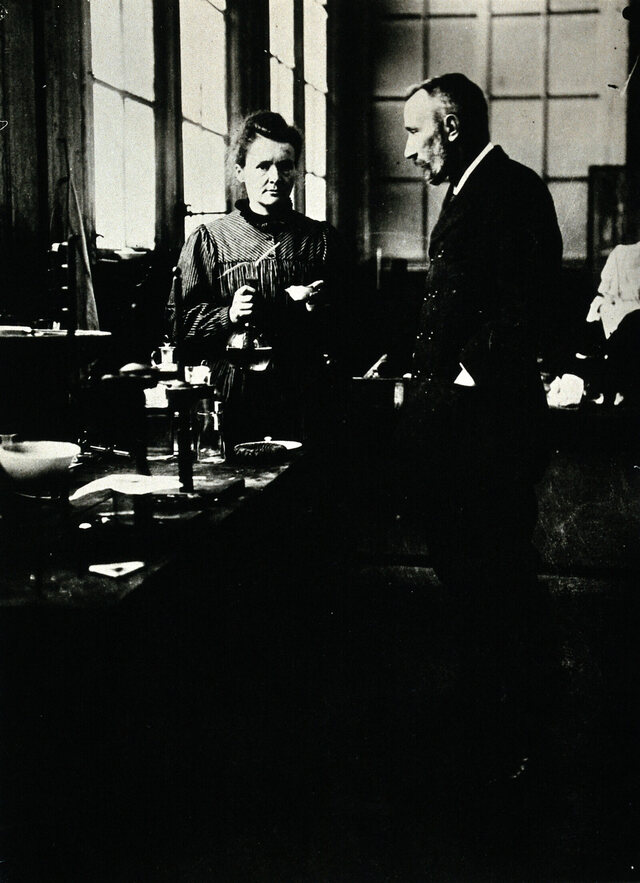
In 1903 the Nobel Prize in Physics was divided: one half went to Becquerel, the other jointly to Marie and Pierre. Pierre was killed in a street accident in Paris in 1906. In 1911 Marie received a second Nobel Prize — in chemistry. She is the only person awarded Nobel Prizes in two different sciences — physics and chemistry. In 1995 the remains of both were moved to the Panthéon in Paris; Marie is the first woman buried there on her own merits.
On the Moon and on Mars there are craters named Curie — after Pierre — and craters named Sklodowska, after Marie (IAU gazetteer). Asteroid (7000) Curie is the only one of these names shared by both. More about Marie: the Maria Skłodowska-Curie Museum in Warsaw and NobelPrize.org.
—
times it would have circled the Sun on its present orbit. One orbit takes about 3 years and 10 months.
Where is it now?
The Sun, the planets and the asteroid at a chosen moment. Distances are to scale; body sizes are enlarged. Drag the timeline or run the simulation forwards or backwards.
More controls: backwards, date, jumps, cameras
Sources and notes
The asteroid belt and background stars are illustrative. Positions: planets — astronomy-engine; asteroid — JPL Horizons ephemeris 1900–2100, a Keplerian approximation outside that window.
Can I see it?
Not with the naked eye. At ordinary oppositions it is magnitude 16–17.5; at the best ones about 14.5–15. The best chances in the coming years are 28 October 2028 (about magnitude 14.5, in Cetus, about 43° above the horizon from Warsaw) and 28 November 2032 (about 14.8, in Taurus, about 61° — higher in the Polish sky). In 2024 amateur astronomers measured asteroid Curie with 20–25 cm telescopes and cameras. We have not established the smallest telescope through which it can be seen by eye at the eyepiece.
Equipment classes are rough and assume dark skies; height above the horizon is at culmination for latitude 52° N.Sources and notes
Is it a threat to Earth? No. The smallest distance between the orbits of asteroid Curie and Earth (MOID, per JPL) is 0.834 au, about 125 million km — more than 300 times farther than the Moon. Its closest approach in 1900–2100 will be on 4 October 2055: 0.843 au. It gets closer to Mars — 0.439 au in April 2013 — but its orbit does not cross the orbit of Mars.
Where it is in the sky over Paris
A full 360° view from the roof terrace of the Tour Montparnasse for the moment chosen in the simulation above (at first — now). The gold crosshair shows where asteroid Curie is in the sky; when it is below the horizon, the label says how far. Drag the panorama to look around.

Sources and notes
The position of asteroid Curie is computed from its orbital elements (JPL), the Sun and Moon from the astronomy-engine library, for an observer on the roof terrace of the Tour Montparnasse, with refraction. Stars: Yale Bright Star Catalogue (to about magnitude 6.5), showing only those visible to the naked eye given city glow, twilight and the Moon (an approximation). Sky colours and city glow are indicative. The magnitude in the label is the asteroid’s predicted apparent V magnitude.
Landscape: a 360° panorama from the roof of the Tour Montparnasse, March 2020 (Daniel Kraft, “Tour Montparnasse 360 panoramic view”), mapped to compass directions — azimuth from the Invalides dome, the Panthéon and the Luxembourg Gardens, vertical from the horizon line and the same landmarks — with a transparent sky and darkened after dusk. The processed file is shared under the same CC BY-SA 3.0 licence.
Distance from Earth over time
Sources and notes
Own computation from JPL Horizons ephemeris (1900–2100) and the astronomy-engine library; Keplerian approximation after 2100.
Next oppositions — table
| Date | Distance from Earth | Magnitude V |
|---|
Where on Earth it can be seen — world map
Sources and notes
2° grid, a day from 12:00 to 12:00 UTC in 15-minute steps; the asteroid’s direction from its orbital elements (JPL), the Sun’s from astronomy-engine; no refraction or parallax (accuracy about 0.5°). Coastlines: Natural Earth 1:110m (public domain). Observatory coordinates rounded to 0.01°.
What if it hit Earth?
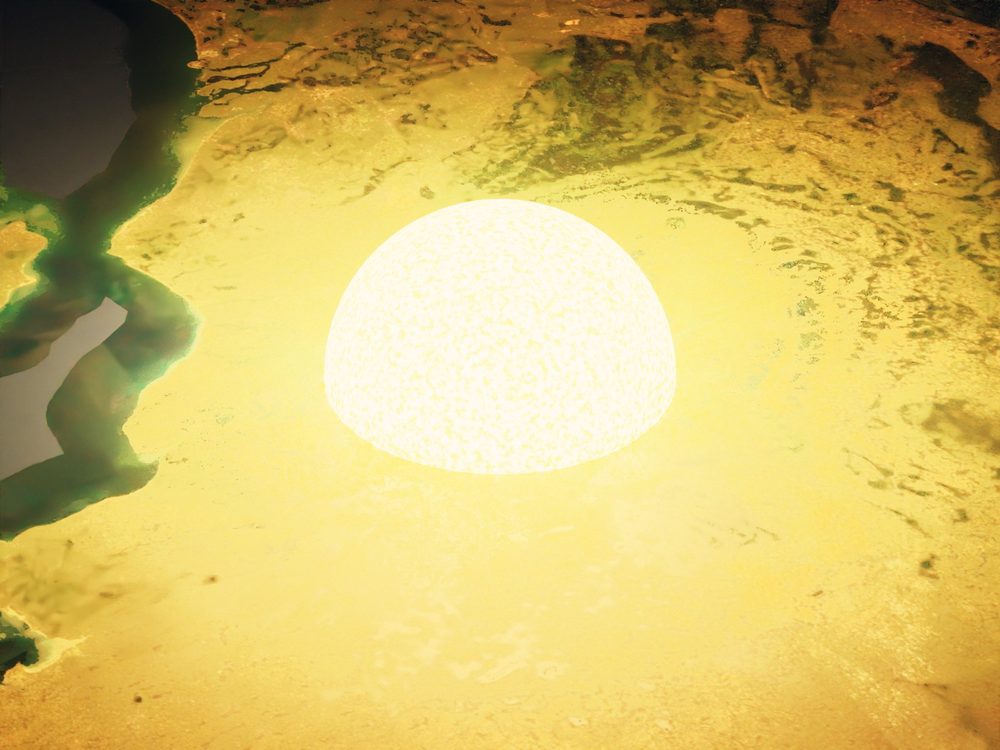
Asteroid Curie poses no threat to Earth (see above). But bodies of this size have struck Earth in its history: according to the same model, on average once every 50 million years or so (6.3 km measurement) to about 80 million years (7.7 km). Below — what would happen to Paris and Western Europe if such a body struck central Paris, in six moments from atmospheric entry to the crater.
A hypothetical collision of a body the size of asteroid Curie — view from orbit
 hypothetical simulation · not a forecast
A fireball about 84 km in radius. Energy about 17,800,000 Mt of TNT — roughly 356,000 times the largest bomb ever tested (Tsar Bomba, about 50 Mt). Thermal radiation lasts about 18.2 min.
Sources and notes
Effects model: G. S. Collins, H. J. Melosh, R. A. Marcus, “Earth Impact Effects Program”, Meteoritics & Planetary Science 40 (2005) 817–840, doi:10.1111/j.1945-5100.2005.tb00157.x, with the crater-depth correction from the authors’ erratum (2013). Assumptions: 20.5 km/s, 45°, sedimentary target rock, body density 2720 kg/m³ (S type); diameter from measurement — 6.29 km (Myhrvold et al. 2022) or 7.72 km (Masiero et al. 2021). The blast model was tested for energies up to about 10,000 Mt; here the energy is about 2,000–3,000 times greater, so the blast and window-breaking ranges are only indicative (the authors allow they may be overestimated several-fold). The model leaves out global effects — climate change after dust and sulphur reach the stratosphere — which for a body this size would be the most serious; for comparison, the body that made the Chicxulub crater was about 10 km across.
Earth imagery: around Paris and in Western Europe Sentinel-2 cloudless by EOX IT Services GmbH (contains modified Copernicus Sentinel data 2016–2017; licence CC BY 4.0), beyond that NASA Blue Marble Next Generation (R. Stöckli, NASA Earth Observatory, via NASA GIBS). Cloud-free sky. The Sun is set for 18 September, about 9:40 Paris time. Render: Blender (Cycles); atmosphere computed separately (Rayleigh and Mie scattering, ozone). The frame widens at later moments to fit the growing effects.
Who discovered it, and how?
The asteroid was discovered on 6 November 1939 by the Belgian astronomer Fernand Rigaux (1905–1962) at the Royal Observatory in Uccle near Brussels (MPC code 012). It received the provisional designation 1939 VD. Rigaux discovered eight asteroids and co-discovered comet 49P/Arend–Rigaux; asteroid (19911) Rigaux bears his name.
Being discovered in 1939 did not mean it was followed from then on. Later it was observed as 1966 UE, 1974 WE1 and 1983 AQ without anyone knowing it was the same asteroid. According to a note in the Polish magazine Urania (1997), H. Kaneda linked the observations and G. Williams computed the orbit from 28 positions at five oppositions in 1939–1996. The name “Curie” was published on 1 July 1996 (MPC 27464); it was proposed by the naming committee, not by an individual.
Today the orbit has uncertainty code 0 — the best on the Minor Planet Center scale. JPL bases it on 8,095 observations from 1939–2026. The asteroid travels in the inner main belt and does not belong to any asteroid family (AstDyS catalogue: a background object). A preliminary classification from Gaia spectra puts it in class S — asteroids with silicate surfaces (Pentikäinen et al. 2026).
A curiosity: 6 November 1939 was the day before the 72nd anniversary of Marie Skłodowska-Curie’s birth. It is a coincidence of dates — nothing suggests the discovery or the name was linked to it; the name came 57 years later. The number 7000 has no connection with the namesakes’ lives either.
For the curious
Figures from the NASA/JPL database and how we compute position, brightness and size.
Data from the NASA/JPL Small-Body Database
Values from the NASA/JPL Small-Body Database, refreshed daily. Every row links to its source.
| Parameter | Value | Source |
|---|
How we computed it
- Orbit
- Orbital elements and brightness from the JPL Small-Body Database. For 1900–2100 the position comes from JPL Horizons tables (every 5 days, including planetary perturbations), interpolated between nodes. Outside that window we use a Keplerian ellipse, and the panel shows an “approximation” badge.
- Planets
- The astronomy-engine library (MIT licence), accurate to about one arcminute.
- Time
- Computations in TDB; from 1972 onwards UTC is converted using the IERS leap-second table.
- Size
- Diameter measured radiometrically (WISE/NEOWISE): 6.29 ± 0.1 km (Myhrvold et al. 2022), 6.497 ± 0.030 km (Masiero et al. 2011), 7.72 ± 1.46 km (Masiero et al. 2021). We do not average the results. There is no diameter from radar or a stellar occultation.
- Rotation
- Disputed period: 6.2134 ± 0.031 h (Lam et al. 2023), 316.8–316.9 h (Gaia: Cellino et al. 2024, MacLennan et al. 2026), 805 ± 20 h (Colazo et al. 2025), 799.7 h (DAMIT 19723). The LCDB light-curve database gives neither a period nor a quality code.
- 3D model
- An artist’s impression: a compact body with proportions consistent with the amplitude of its brightness changes (0.29 mag; Colazo et al. 2025). The DAMIT 19723 shape model (CC BY 4.0 licence) has a quality rating of 1.5 on a 0–5 scale and no scale, so we do not show it.
- Apparent magnitude
- The H, G system with H = 13.03 and G = 0.15; without variation caused by rotation.
- Mass and moon
- No measurement of mass, density or a satellite was found. A missing database entry does not prove there is no moon.